There are some people we meet for a few minutes and forget by the next morning.
And then there are people who stay with us long after we’ve left them behind. I met one such person on a quiet summer night in Ramnagar.
Last month, while returning to Delhi after a family holiday in Kumaon, we decided to halt for the night near Jim Corbett. It had been a long day. Everyone was tired, and the sensible thing to do was sleep.
Around one in the morning, my brother walked into the room and asked the same question he has been asking me for years. “Chalte hain?”
With him, that question has never required context. In our early working years in Delhi, when we shared an apartment, midnight adventures were routine. I would be half asleep when he would wake me up. “Are you sleeping?”
Before I could answer, he would already be looking for his car keys. The next thing I knew, we would be driving across the city in search of paranthas, Maggi, chai, or some forgotten dhaba tucked away in a corner of Delhi. I often complained. I never regretted going. I always enjoyed it. So that night in Ramnagar, when he suggested another drive, I agreed almost instinctively. My husband and I got into the car.
“I am taking you somewhere wonderful,” my brother announced confidently. As we drove deeper into the darkness, my curiosity grew. The road wound through stretches of forest. The jungle felt alive. Every sound seemed amplified. While my brother appeared perfectly relaxed, I was busy imagining what this “wonderful place” could possibly be.
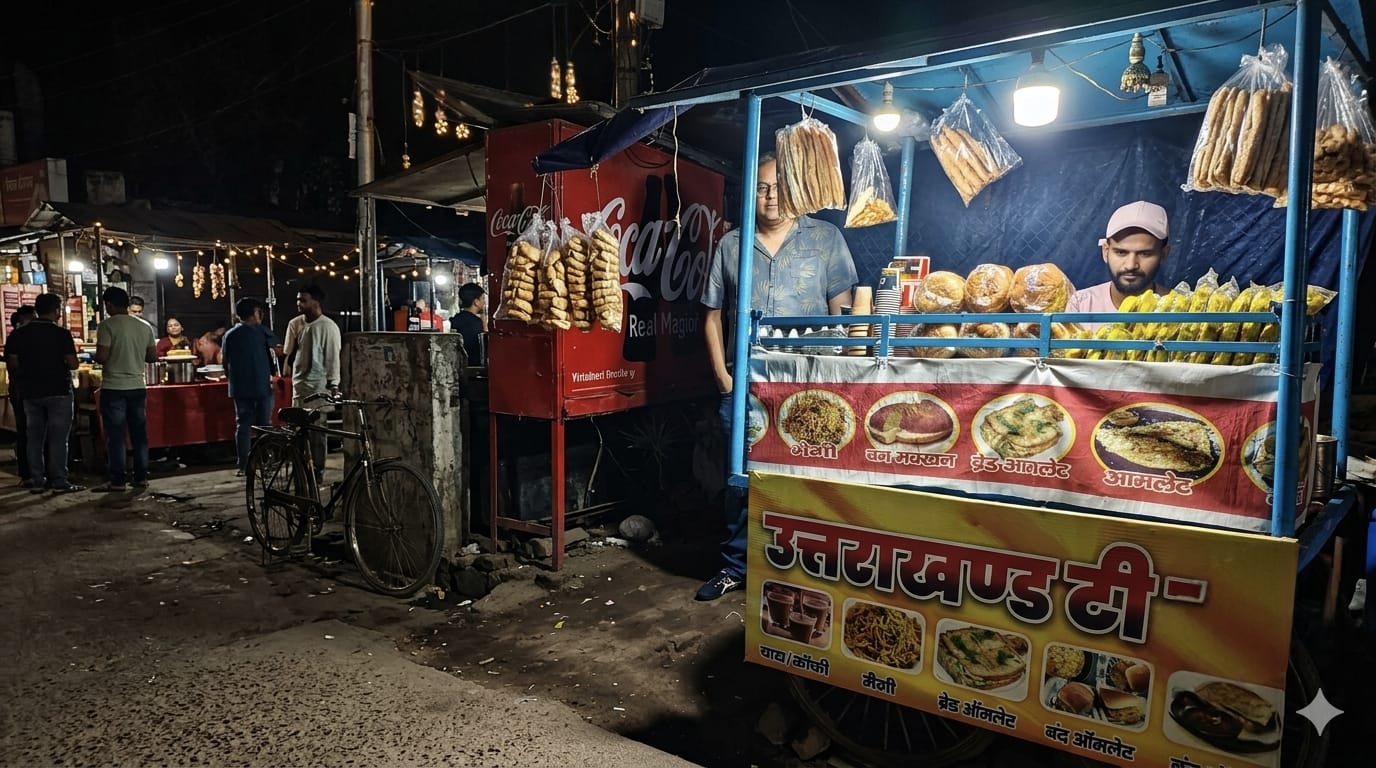
After nearly thirty minutes, he slowed down and parked beside a row of small roadside stalls opposite the Ramnagar Bus Depot. I looked around, slightly puzzled.
Fruit vendors stood on one side of the road. A few food stalls glowed under yellow lights on the other. It looked ordinary. Very ordinary.
My brother walked straight toward one of the stalls. The man behind the counter looked up. The moment he saw my brother, his face broke into the widest smile. He stepped out immediately, wiped a stool carefully, and gestured for my brother to sit. There was such genuine affection in that small interaction that I found myself watching silently. The two of them began communicating through gestures and expressions.
I turned to my brother. “Who is he?” My brother smiled. “This is Naseer. He’s deaf and mute.” I watched more carefully.
Naseer looked at me, then at my brother, and began signing animatedly. My brother responded just as naturally. Soon both of them were laughing. “What is he saying?” I asked. “He wants to know how you’re related to me.” Apparently, Naseer found it impossible to believe that I was older than my brother. When my brother insisted it was true, Naseer laughed even harder. Then he pulled another stool toward me, dusted it carefully, and offered it with such warmth that I couldn’t help smiling back.
A few more gestures followed. My brother translated. “He says you cannot leave without having his chai and Maggi.” The order, it seemed, was non-negotiable. As we sat there waiting, I asked my brother another question. “How long have you known him?” My brother grinned. “I have visited him couple of times.”
“And what’s his full name?” His grin widened. “Honestly? He never told me.” “What?” I stared at him. “Then how do you know his name is Naseer?” My brother burst out laughing. “UPI transaction.” For a moment, all of us laughed together.
There was something wonderfully simple about it. No introductions. No background stories. No exchange of phone numbers. Just few visits, some chai, smiles, gestures, and human connection. The kind that seems increasingly rare.
Soon, the tea arrived. Then the Maggi. Was it the best Maggi I have ever eaten? Probably not. Was it the most memorable? Without question. Because what stayed with me wasn’t the food. It was Naseer.
His smile carried a childlike mischief. His eyes sparkled with warmth. There was no trace of self-pity, resentment, or frustration. He welcomed people without speaking a single word. He made strangers feel seen. He created connection where most of us struggle despite having language. As I watched him move around the stall, greeting customers, laughing through gestures, and taking genuine joy in their presence, a thought quietly surfaced.
How easily we complain, the traffic is too much. The work is too stressful. Life isn’t fair. People don’t understand us. We spend years waiting for the perfect circumstances before allowing ourselves to feel happy. And yet here was a man who, by conventional standards, had every reason to be bitter. But bitterness was nowhere to be found. Only contentment. Only presence. Only joy.
Perhaps that is why my brother called this a wonderful place. The place itself was never the attraction. Naseer was. As we drove back through the sleeping forest that night, I understood something about my brother that I had always known but never fully appreciated. My brother has always had an unusual gift of noticing good people. Not important people. Not influential people. Just genuinely kind human beings. And somehow, they notice him too.
As we grow older, I’ve realised that this may be one of life’s greatest privileges, not collecting achievements, but collecting people. The ones who restore your faith in humanity. The ones who remind you that goodness still exists in ordinary places.
Months have passed since that night. I still remember Naseer. Not because of what he said. But because of what he reminded me. That connection does not depend on language. That dignity does not depend on circumstance. And that happiness is often far simpler than we make it.
So, if you ever find yourself driving through Ramnagar late at night, stop at the small stall opposite the bus depot. Order a cup of chai. Maybe a plate of Maggi. And if Naseer is there, don’t be surprised if you leave carrying something far more valuable than either.
Some people serve tea. Some people quietly restore your faith in humanity.
A Midlife Baithak Reminder
Some of life’s greatest lessons don’t come from extraordinary moments. They arrive quietly, through ordinary people, unexpected encounters, and conversations that stay with us long after they’re over.